
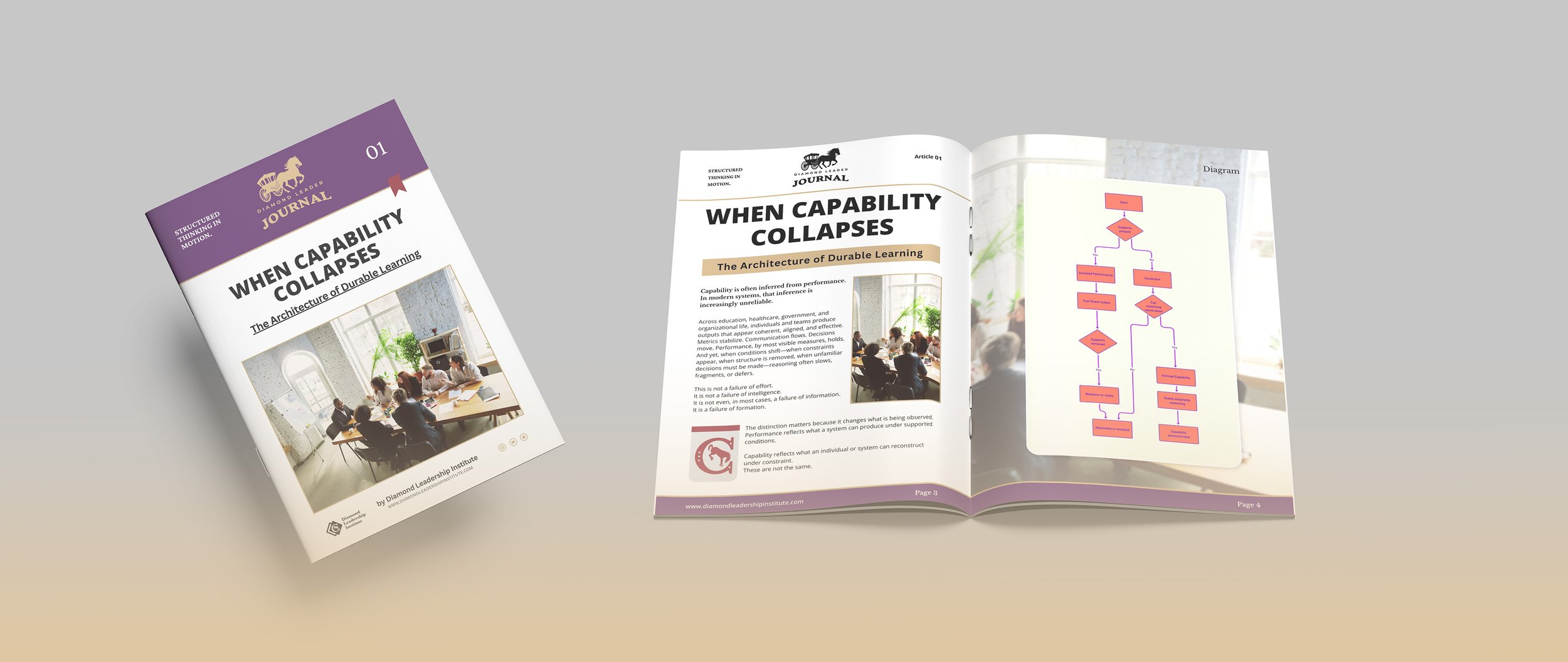
When Capability Collapses
The Architecture of Durable Learning
Part I
Play Audio
Capability is often inferred from performance.
In modern systems, that inference is increasingly—and quietly—wrong.
Across education, organizations, and institutions, performance appears stable: outputs align, communication flows, decisions move.
And yet, when conditions shift—when structure is removed or constraint appears—reasoning often slows, fragments, or defers.
This is not a failure of effort, intelligence, or information.
It is a failure of formation.
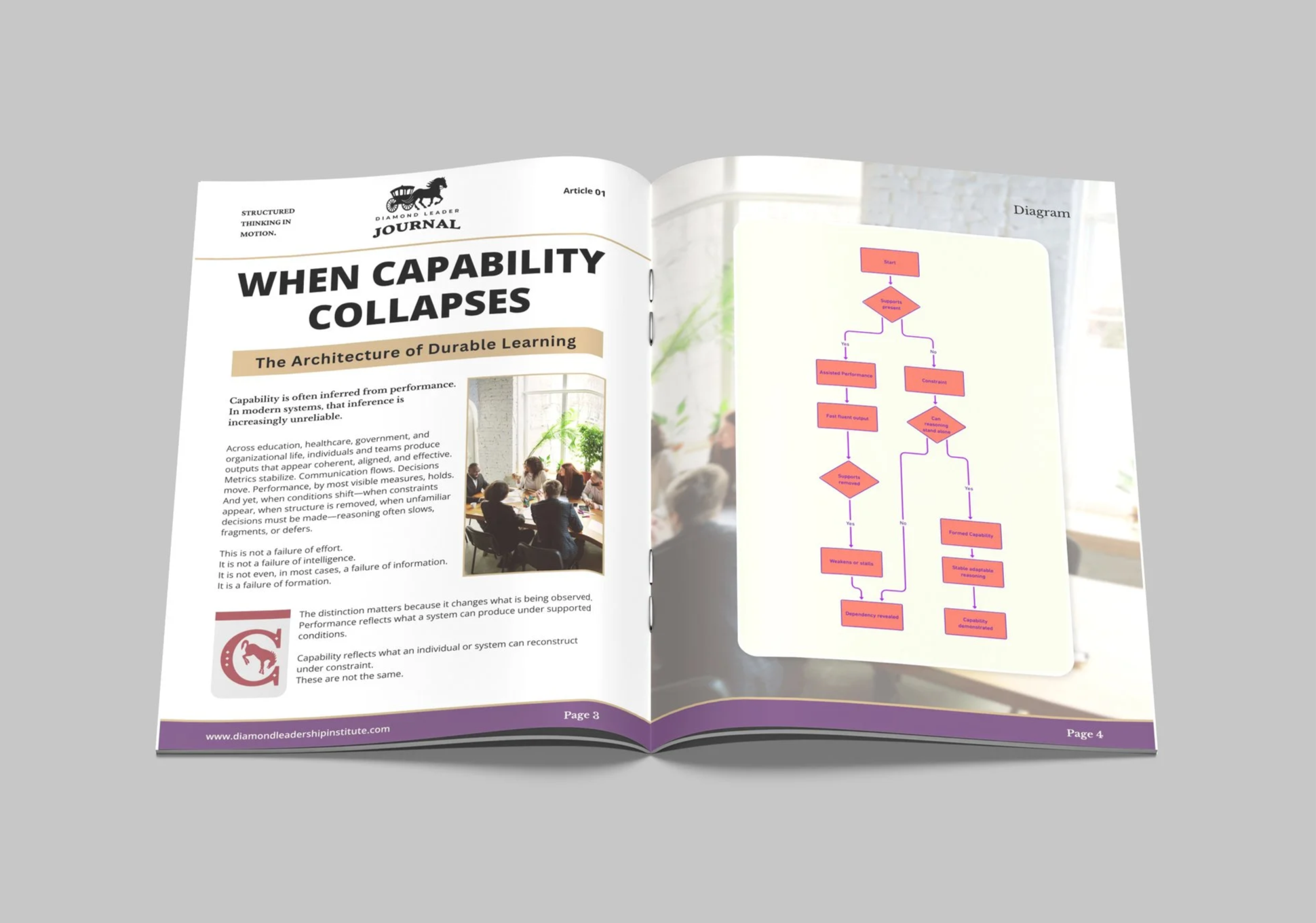
Performance reflects what a system can produce under supported conditions.
Capability reflects what can be reconstructed under constraint.
These are not the same. The more structured the environment, the harder this distinction is to detect.
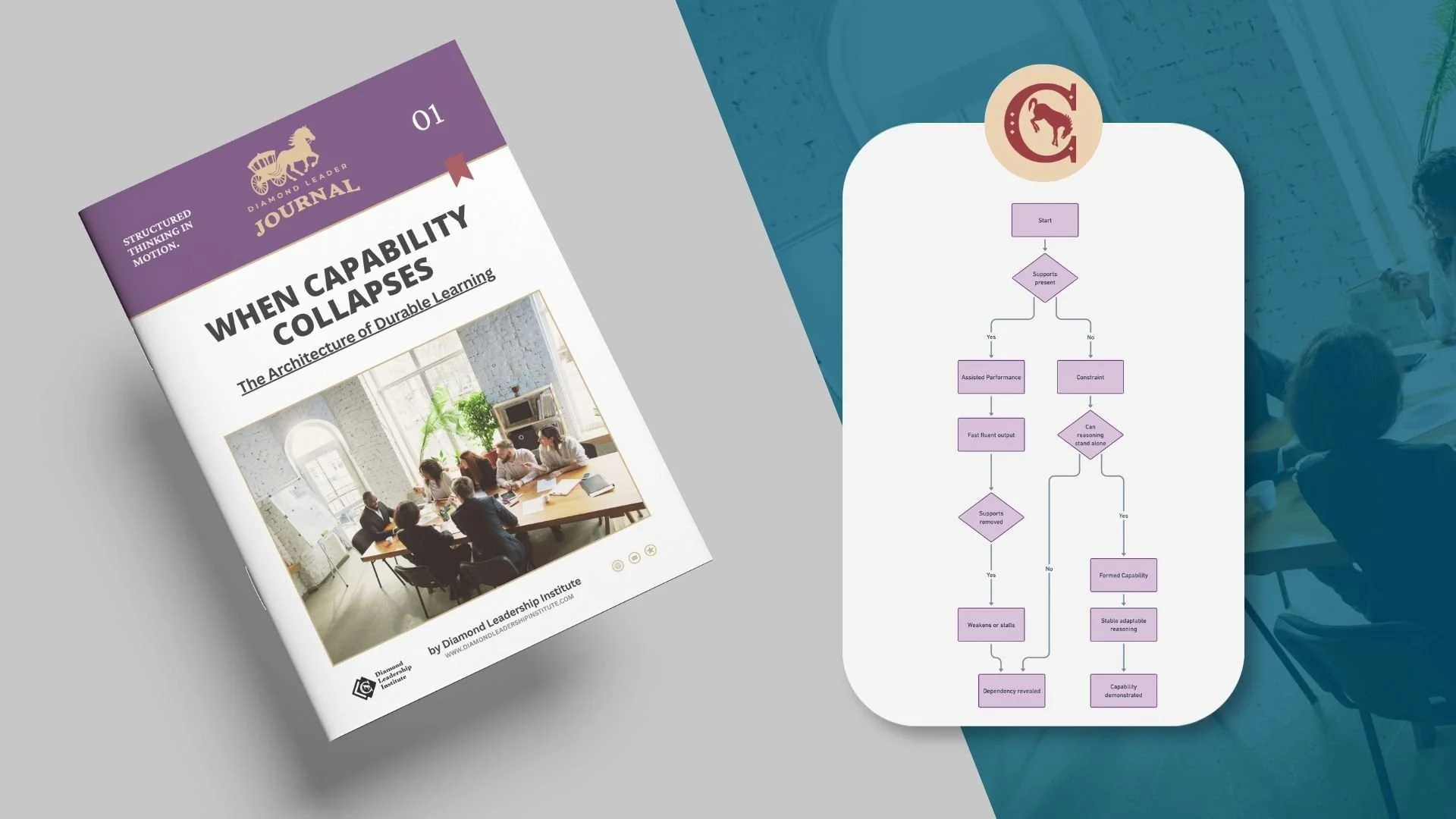
CLICK ON IMAGE TO ENLARGE
The Misleading Signal
Modern systems are designed to support performance.
They provide: templates, prompts, dashboards and predefined structures.
Within these environments: decisions move efficiently, explanations sound precise and outputs align.
These are real outputs. But they are produced within externally structured reasoning environments.
The question is not whether performance exists.
The question is whether it is dependent.
The Distinction
To see this clearly:
Assisted Performance
Execution that depends on external support.
Formed Capability
The ability to reconstruct and apply reasoning independently.
Durable Learning
Learning that remains usable under constraint.
A system can produce strong performance while weakening capability.
This is where misinterpretation begins.
Where It Becomes Visible
The difference is rarely visible under stable conditions. It appears under constraint.
Remove the structure: no prompt, no template, no predefined sequence.
Then ask: What matters most—and why? What tradeoffs are required?
If reasoning must be deferred or rebuilt externally, performance was present—but capability was not fully formed.
Nothing breaks.
But something essential becomes visible: the system cannot yet hold its own reasoning.
The Hidden Dependency
Assisted performance often looks like capability.
It produces: fluent explanations, aligned outputs and confident communication.
These signals create trust—until the environment changes.
When structure no longer contains the problem, dependency is revealed: hesitation, deferral, need for more input.
This is the signature of fragile learning: it performs within structure but weakens without it.
Why This Happens
This pattern is structural.
Systems optimize for what is: visible, measurable, and scalable.
They reward: speed, clarity, completion
Formation requires something different: independent construction, reorganization of ideas, and application across contexts.
These are slower and harder to measure. So they are reduced.
The Consequence
When performance is mistaken for capability:
Individuals: struggle under constraint, rely on structure, transfer inconsistently.
Systems: slow down in unstructured conditions, increase oversight, depend more on external input
These are not failures. They are compensations.
The Illusion
The greatest risk is not poor performance. It is misinterpreted performance.
Systems begin to reward:
articulation over reconstruction
completion over independence
speed over stability
Performance improves.
Confidence increases.
Capability remains uneven. Until constraint appears.
Constraint does not create the weakness.
It reveals it.
A More Accurate Standard
The standard must shift: What can be done without support?
Can reasoning be:
reconstructed independently?
applied across contexts?
sustained under pressure?
If not, performance has exceeded formation.
What This Article Establishes
This is not an argument against tools or systems. It is an argument about misinterpretation.
Performance is real. But it is not evidence of capability. Capability is revealed under constraint.
Most systems are not designed to see this clearly.
They are designed to sustain performance.
Durability is not fluency within structure.
It is independence from it.
And if that distinction is not measured, it is not developed.
Formation Implications
To build durable capability:
Separate performance from formation
introduce constraint deliberately
Measure reconstruction—not just completion
Remove support before inferring capability
Reflection Questions
Where does your system rely most on structure?
What happens when that structure is removed?
Where might performance be mistaken for capability?
How is independent reasoning measured?
What would change if capability—not output—became the standard?
READ NEXT