

The Body Is Not Optional
The Architecture of Durable Learning
Part III
Play Audio
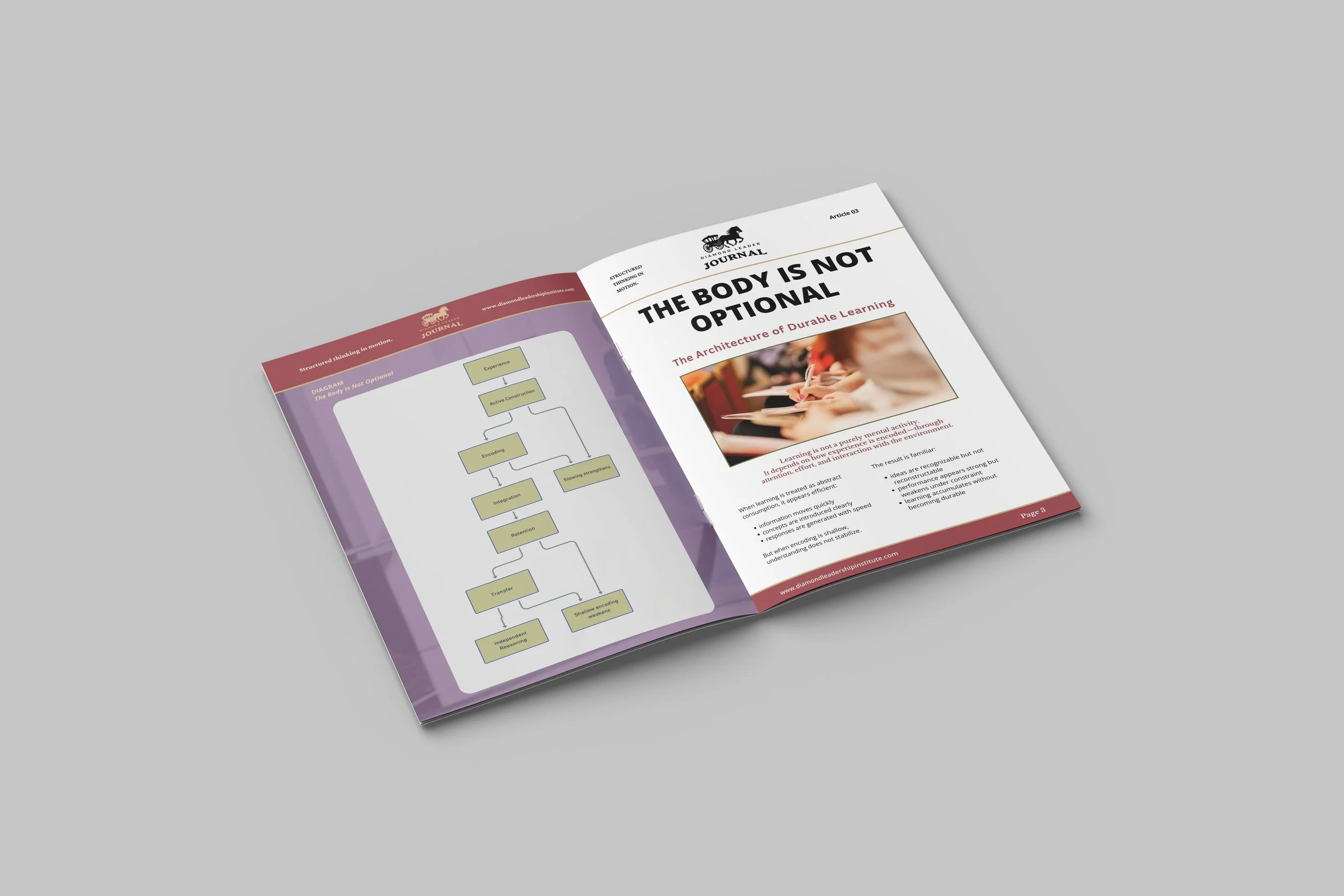
Learning is not a purely mental activity.
It depends on how experience is encoded—through attention, effort, and interaction with the environment.
When learning is treated as abstract consumption, it appears efficient: information moves quickly, concepts are introduced clearly, responses are generated with speed
But when encoding is shallow, understanding does not stabilize.
The result is familiar: ideas are recognizable but not reconstructable, performance appears strong but weakens under constraint learning accumulates without becoming durable
This is not a failure of content.
It is a consequence of how learning is formed.
Encoding Determines Durability
Before knowledge can be used, it must be encoded.
Encoding is the process by which experience becomes retrievable and usable. When encoding is strong: recall is reliable, reasoning is stable, transfer is possible. When encoding is weak: recall fragments, reasoning collapses under pressure, application fails outside familiar contexts.
The difference is not intelligence or motivation. It is structure.
A concept feels familiar. Language is recognizable. An explanation can be followed when presented. This creates a powerful signal: “I understand this.” But recognition is not reconstruction.
Recognition allows:“I’ve seen this before.”
Reconstruction allows:“I can build this again—without assistance.”
A concept that cannot be: explained without prompts, reorganized independently, applied in a new context - has not been formed. It has been encountered.
CLICK ON IMAGE TO ENLARGE
The Role of the Body
The body is not separate from cognition.
It is one of the conditions through which cognition forms.
Thinking is shaped by interaction—not just internal processing.
In practice:
1. Attention is anchored through action
Writing, organizing, and constructing reduce passive consumption and stabilize focus.
2. Effort introduces constraint
Movement takes time. Construction requires selection. This prevents shallow processing.
3. Multiple systems integrate experience
When visual, motor, and cognitive processes work together, encoding strengthens.
This does not require complex activity.
It requires active construction—not just exposure.
Modern systems optimize for speed: rapid delivery, fast response, efficient output.
These conditions support performance. They often weaken encoding.
Why Speed Weakens Encoding
When processing is too fast: attention fragments, ideas remain unorganized, connections stay shallow.
The result is familiarity without stability. The learner recognizes the idea—but cannot reconstruct it.
Slowing as a Structural Condition
Slowing is often treated as inefficiency. In formation, it is functional. It forces: selection of what matters, organization of ideas, integration across elements.
This is why physically writing often strengthens retention. Not because handwriting is inherently superior— but because it introduces constraint.
Constraint requires thought.
Thought strengthens encoding.
Cognitive Load and Fragmentation
Encoding is also shaped by cognitive load. When too many elements are introduced at once: attention divides, processing becomes shallow, integration weakens.
This occurs when: multiple inputs compete, tasks are layered without sequence, tools compress complexity without reducing it.
Under these conditions, learners appear engaged—but understanding remains unstable.
From Encoding to Capability
Encoding shapes more than memory.
It shapes capability. When encoding is strong: knowledge can be retrieved under pressure, reasoning can be reconstructed, understanding transfers across contexts.
When encoding is weak: recall depends on cues, reasoning depends on structure, transfer becomes inconsistent. This is why performance appears stable within systems—but weakens when those systems are removed. The issue is not access to knowledge. It is how that knowledge was formed.
A Pattern Across Systems
This pattern appears wherever learning is structured.
In classrooms: content is delivered efficiently, participation is high, retention is uneven.
In organizations: tools guide execution, prompts structure thinking, independent reasoning weakens under constraint.
In leadership: decisions rely on prepared materials, explanations follow familiar patterns, adaptation slows when structure disappears.
Where encoding is shallow, capability becomes dependent.
Clarifying the Misinterpretation
This is not: a rejection of technology, a preference for traditional methods.
The issue is not the presence of tools.
It is their placement.
When digitization precedes construction, encoding weakens.
When construction precedes digitization, encoding strengthens.
This is structural—not ideological.

Formation Implications
If durability depends on encoding:
Sequence construction before optimization
Require retrieval without prompts
Introduce constraint deliberately
Manage cognitive load during formation
What This Essay Establishes
Learning that is only encountered remains fragile.
Learning that is constructed becomes durable.
The difference is not philosophical. It is biological.
Where learning bypasses effortful engagement, encoding weakens.
Where encoding weakens, reasoning becomes unstable under constraint.
The body is not a delivery mechanism for the brain.
It is part of how the brain learns.
Durable learning does not begin with abstraction.
It begins with contact—and is strengthened through construction.
Reflection Questions
Where does your system rely primarily on abstract exposure?
How often are ideas reconstructed without prompts?
What role does effortful engagement play in learning?
Where might speed be weakening encoding?
How is cognitive load managed during formation?

Diamond Leader Journal
The Journal is a private membership for leadership, learning, reflective practice, systems stewardship, and human development.